



The right direction ...
For customers, the right direction means innovation and new service options, backed by reliability, visibility of operations and ease of doing business.
For shareholders, it is industry-leading returns on their investments by strengthening the company’s financial position – increasing revenues, containing costs, improving asset utilization, reducing debt and increasing dividends.
For employees, it is a culture that embraces diversity and enables all to contribute toward meeting the company’s business goals.
For communities, it is the security of solid corporate citizenship and a connection to global commerce, supported by marketing and economic development expertise.
For all, it is the steady progress Norfolk Southern maintained during 2002, despite economic and international uncertainty.
Employees received their 13th consecutive E. H. Harriman Memorial Gold Medal Award for achieving the best safety record among the nation’s largest railroads.
NS completed rollout of its redesigned service network, called the Thoroughbred Operating Plan, or TOP. Customers acclaimed the benefits of the plan. Service consistency, transit time, on-time performance and interline service improved. New information systems and e-commerce applications further improved service and gave customers more real-time data about their shipments.
TOP optimizes NS operations. A simplified, scheduled network routes traffic more directly, improves asset utilization and raises capacity for handling traffic growth. TOP enhancements during 2003 and 2004 will provide reliable dock-to-dock tracking of shipments.
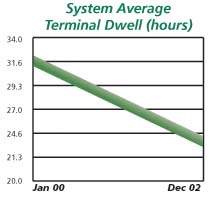
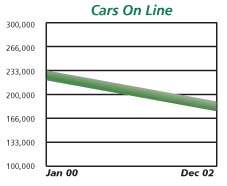
Operating efficiencies also drove higher-value service. Principal measurements of rail network performance – system average train speed and terminal dwell, and number of cars on line – all set record bests for NS. TOP contributed to the improvement in those metrics and in on-time performance.
Net Income, Earnings Per Share Rise
Operations and service improvements contributed to increasing revenues and lowering costs, which strengthened NS’ financial performance.
 Net income
increased 23 percent in 2002 compared with 2001. Earnings per share increased
22 percent and were higher for the third consecutive year.
Net income
increased 23 percent in 2002 compared with 2001. Earnings per share increased
22 percent and were higher for the third consecutive year.
In July,
NS increased the dividend on its common stock from 6 cents to 7 cents.
NS stock
outperformed the S&P 500 index in 2002 by 32.5 percentage points.
Market-value
pricing, coupled with rigorous cost controls and savings, led to improvement
in the company’s operating ratio.
NS has
produced year-over-year improvement in the operating ratio for each quarter
since the second quarter of 1999.
NS is
committed to reducing outstanding debt as free cash flow is generated.
Long-term debt has been reduced by $695 million since the beginning of
2000. NS’ share of Conrail’s long-term debt has declined $256
million. The total three-year reduction in debt obligations is $951 million.
NS credit
ratings remain among the best in the industry, reflecting the company’s
emphasis on solid financial performance.
Innovations Spur Gains
New service options strengthened rail business for NS and provided nontraditional revenue sources as well.
MODALGISTICS
and TransWorks, which coordinate and support supply chain management services,
both developed independent revenue streams as start-ups.
General
merchandise revenue was up 3 percent. Revenue per car increased 2 percent
over 2001 and was more than 7 percent better than 2000.
Intermodal
traffic led the rail industry with the highest rate of growth in 2002.
Trailer and container intermodal revenue increased 6 percent on 7 percent
greater volume.
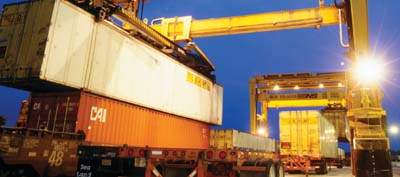
NS’ Triple Crown Services revenue was up 3 percent on 4 percent volume growth. NS launched a number of intermodal product expansions and service partnerships with other carriers.
Investments Support Business Growth
 NS
capital expenditures of $695 million in 2002, together with prior years’
investments in service improvements and anticipated spending in 2003,
position the company to handle business growth.
NS
capital expenditures of $695 million in 2002, together with prior years’
investments in service improvements and anticipated spending in 2003,
position the company to handle business growth.
In 2003, NS plans to spend $798 million for capital improvements. The
anticipated spending includes $499 million for roadway projects and $246
million for equipment.
The largest expenditure, $383 million, will be for maintaining and improving the company’s infrastructure – rail, crossties, ballast and bridges. Another $36 million is earmarked for marketing and industrial development initiatives to serve coal, automotive and intermodal customers.
Projected equipment spending includes the purchase of 100 six-axle locomotives, which follows the purchase of 50 locomotives in 2002.
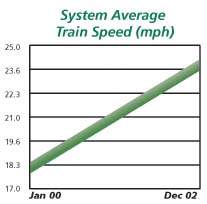 |
| A 32 percent increase in system average train speed from 18 mph to 24 mph reflects improvements in operations that enhance customer service. |
|
|
| A 30 percent improvement in the amount of time rail cars spend in terminals – from 32 hours to 22 hours – translates to better delivery times for customers. |
|
|
| A 19 percent improvement in number of cars on line from 226,159 to 183,877 demonstrates the fluidity of NS’ network, which creates additional capacity for handling business growth. |
|
|
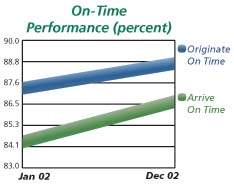
| This graph shows on-time improvement for merchandise, multilevel, auto parts and intermodal trains. On-time origination improved from 87 percent to 89 percent. On-time arrivals improved from 84 percent to 87 percent. |
“We are very impressed with how Norfolk Southern used innovative thinking to bring something of substance to us that will be a win-win situation for all parties.”
— Ed Palmer
Eastman Chemical Company
Prior to September 2002, coal for Eastman’s Kingsport, Tenn., manufacturing site was unloaded at four plant receiving locations in relatively small rail car increments. Palmer, logistics sourcing manager, said the coal delivery system was somewhat inefficient, difficult to manage and caused rail car congestion inside the facility.
“Norfolk Southern brought the idea of a centralized coal unloading facility to Eastman, along with a study to determine if it would be feasible,” Palmer said. The challenges were complex. Coal would have to be conveyed to the four different receiving locations and across a river that runs through the plant.
The solution was a unit coal train rotary dump facility with conveyance systems to the four plant receiving locations. Designed, built and operated by a third party, the facility began operation in September and is capable of handling 60- to 85-car unit trains five to seven times per week. Coal is unloaded in a few hours on the same day it arrives, compared to three or four days previously, creating efficiencies for both Eastman and NS.
“The innovation was that NS brought the idea to us and worked well with us on options planning and contract structure,” Palmer said. Eastman and its lead logistics provider, Cendian Corporation, an Eastman subsidiary, continue to work with NS to fine-tune the operation.
“Norfolk Southern has not only met but in many cases exceeded our expectations and, more importantly, the expectations of our customers relative to service. The proof of that has been in our ability to continue to grow this business on NS and in our entire transcontinental network year over year.”
— Paul Bergant
J.B. Hunt Transport Services, Inc.
J.B. Hunt is a diversified transportation company providing one-way truckload, intermodal and dedicated contract services. In the East, it relies predominantly on NS for rail intermodal handling of shipments, mostly containerized traffic. “We rely on the whole NS network,” said Bergant, executive vice president, chief commercial officer and president of J.B. Hunt’s intermodal division.
“Norfolk Southern is our primary carrier for all intermodal requirements in its network for both local freight and transcontinental business.
“You’ve given us the type of service that has allowed us to grow our product. Our customers have been satisfied to continue to give us more business. That’s the proof of it.”